
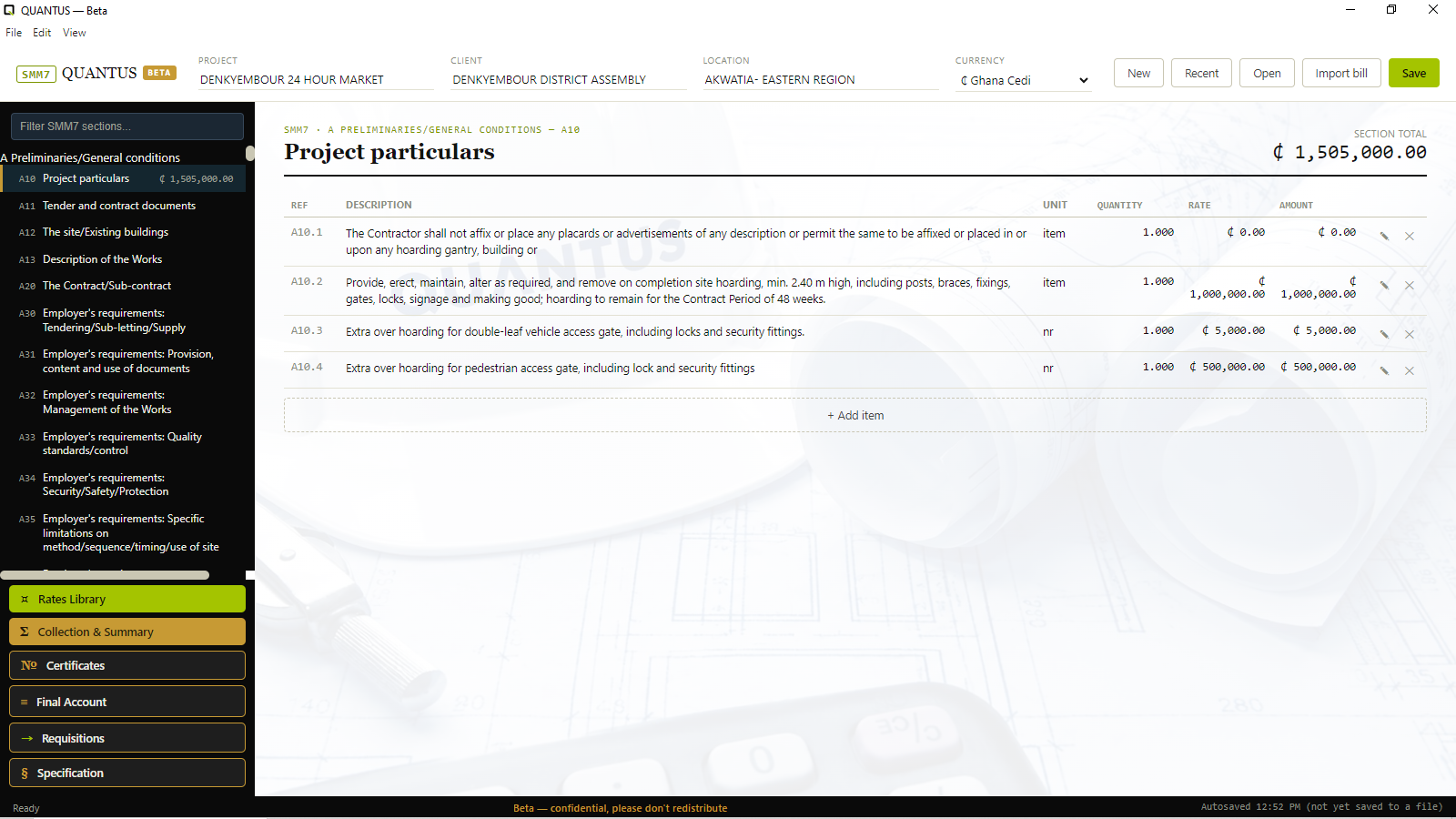
The Bill of Quantities is the document that most people associate most immediately with the quantity surveyor. It is the thing the QS makes. Ask a civil engineer what a QS produces, and they will say “the BoQ.” Ask a contractor what they need before they can price a job, and they will say “the BoQ.” It is, in this sense, the signature output of the profession.
It is also the document that, when prepared badly, causes more professional damage to quantity surveyors in Ghana than almost anything else.
A poorly prepared BoQ does not just produce a bad tender result. It can trigger a procurement failure, expose an entity to legal challenge, create disputes that outlast the project itself, and place the QS who prepared it in a position of personal professional liability. In Ghana’s public sector, where the BoQ is embedded in the Standard Tender Document used for competitive tendering, the stakes are particularly high.
This article covers what the BoQ is, how it functions within Ghana’s procurement framework, what the most common errors look like, and how a well-prepared BoQ protects both the project and the QS who produced it.
What the BoQ actually is — and what it is not
The Bill of Quantities is a measured schedule of the work required to build a project. It itemises the work by trade and element, describes each item in accordance with a recognised measurement standard, and provides quantities expressed in appropriate units — cubic metres of concrete, square metres of formwork, linear metres of kerbing, and so on.
In a lump sum contract based on a BoQ, the contractor prices each item at a rate per unit, multiplies rate by quantity, and arrives at a total for each item. The sum of all items gives the contract sum. This is the price the client will pay — subject to adjustment for variations and remeasurement where the contract so provides.
The BoQ is not, however, a design document. It does not specify how the work should be done. It does not replace the drawings or the specification — it works alongside them. The drawings tell the contractor what to build. The specification tells them to what standard. The BoQ tells the QS and the contractor what quantity of each element is required, and provides the mechanism for pricing, valuation, and variation assessment.
This distinction matters, because one of the most common BoQ errors — particularly in Ghana’s construction market — is treating the BoQ as a substitute for proper technical documentation. A BoQ item that describes “reinforced concrete column” without a cross-reference to a drawing or specification is not a complete item. It leaves the contractor to make assumptions, and wherever assumptions differ between tenderers, comparability is lost.
The BoQ within Ghana’s Standard Tender Documents
In Ghana’s public sector, the BoQ is not a standalone document. It is one component of the Standard Tender Document — the complete package of documents that a public entity issues to tenderers when inviting bids under National Competitive Tendering or other formal procurement methods.
The STD is structured to be used in conjunction with the applicable conditions of contract. For building works, the relevant conditions are typically those of the Ghana Institute of Architects / Association of Consulting Engineers Ghana suite. For civil works, the FIDIC conditions of contract (often the Red Book for construction) are commonly used, sometimes in a locally adapted form.
The BoQ’s position within the STD has important implications:
The BoQ defines the pricing basis. When a contractor prices the BoQ and the tender is accepted, those rates become the contractual basis for valuation throughout the project. Variations will be valued at these rates (or at rates derived from them, where a direct rate does not apply). Interim valuations will be based on measured quantities applied to these rates. Errors in the BoQ rates — or rates that are too low because the description was inadequate — become built-in financial problems.
The BoQ creates comparability. Because all tenderers are pricing the same quantities to the same descriptions, the Entity Tender Committee can compare tenders on a like-for-like basis. Where BoQ descriptions are ambiguous or incomplete, contractors make different assumptions — and comparability is lost. The lowest price on paper may not represent the lowest price in reality, because it may have been built on a narrower interpretation of the scope.
The BoQ supports tender evaluation. During evaluation, the ETC (advised by the QS) will scrutinise individual rates as well as the total price. Rates that are significantly below market levels — whether for individual items or across the bill — are a red flag that requires investigation. This analysis is only possible if the BoQ is detailed enough to support it.
Measurement standards and why they matter
A BoQ is only useful if its quantities can be independently verified. This requires that the measurement be carried out in accordance with a recognised, documented standard — so that another QS, reviewing the document, can understand exactly what is included in each item and check the arithmetic.
In Ghana, BoQs for building works are conventionally measured in accordance with the Standard Method of Measurement — either the SMM7 (the Seventh Edition of the Standard Method of Measurement published by the Royal Institution of Chartered Surveyors) or the New Rules of Measurement (NRM2), which is its successor. For civil engineering works, the Civil Engineering Standard Method of Measurement (CESMM) is the relevant reference.
These documents are not light reading. They specify, in considerable detail, how each type of work should be measured — what is included in each unit, what is measured separately, what is deemed included (and therefore not measured separately), and how complex situations should be handled.
The consequence of not following these standards is not just technical imprecision. It is professional inconsistency. When one QS measures the substructure of a building including the earthwork support to excavations within the rate for excavation, and another QS measures earthwork support separately, their BoQs are not comparable — even if the physical scope of work is identical. Contractors who know the rules will exploit discrepancies. Those who do not will price incorrectly.
The most common BoQ errors in Ghana’s construction market
Years of practical experience in Ghana’s construction market reveal the same BoQ errors appearing repeatedly. Recognising them is the first step to eliminating them.
Inadequate item descriptions
The most pervasive error. BoQ items that describe work in vague or incomplete terms — “supply and fix timber frames,” “reinforced concrete work,” “blockwork” — without specifying dimensions, specification references, finishes, or other particulars that affect cost. A contractor pricing these items must make assumptions, and different contractors make different assumptions.
Good item descriptions are specific. They reference the relevant drawing or specification clause. They give dimensions where the measurement method requires them. They distinguish between materials of different grades or finishes where those distinctions affect cost.
Quantity errors
Arithmetic errors in the take-off are surprisingly common — and surprisingly consequential. A concrete item measured in cubic metres where the correct quantity is, say, 120 m³ but the BoQ states 12 m³ will attract an abnormally low total price for that item, distort the tender total, and create a remeasurement problem when the actual quantity is established.
In a remeasured contract, quantity errors correct themselves at final account — but they distort the interim payment process and can create cash flow problems for the contractor that lead to disputes. In a lump sum contract, the consequences depend on whether the contract treats BoQ quantities as approximate or firm.
Missing items
Items that have been omitted from the BoQ — either through oversight or because the QS considered them too minor to measure separately — create gaps that contractors must either price speculatively or claim as extras during construction. Neither outcome is good.
The risk of omissions is greatest in complex projects where the interface between trades is not clearly defined, and in projects where the design is not sufficiently developed at the time the BoQ is prepared. A BoQ prepared from incomplete drawings will always have gaps — which is an argument for not procuring until the design is sufficiently advanced.
Preliminary items priced incorrectly
The Preliminaries section of the BoQ covers the contractor’s general and site costs — management, supervision, temporary works, plant, welfare facilities, security, and so on. These items are not part of the measured work — they are the costs the contractor incurs in setting up and running the site.
Preliminaries are frequently under-measured, poorly described, or given inadequate weighting in the BoQ structure. The result is that contractors who price accurately in the measured work items may under-price the preliminaries (because the BoQ items do not give them enough to price against) or over-price them (because the risk of inadequate site cost recovery is absorbed in a lump sum contingency).
Failure to separate materials and labour
In markets like Ghana’s, where labour costs, material costs, and productivity rates can vary significantly between contractors and between regions, it is often valuable to separate materials and labour in the BoQ. This supports evaluation — the ETC can assess whether a contractor’s labour rates are realistic for the location — and supports claims management, where the ability to break out materials and labour is often essential.
How BoQ errors trigger procurement and legal consequences
In Ghana’s public sector framework, a BoQ error does not stay contained within the financial management of the project. It can trigger consequences that extend into procurement compliance and legal territory.
Threshold breach. If a BoQ error causes the tender sum to materially differ from the pre-tender estimate, the entity may find itself in a position where the awarded contract value places it in a different procurement threshold category. This can mean the approval level was incorrect, the procurement method was wrong, or the contract should have been referred to the TRB but was not.
Re-tendering trigger. Where a BoQ error is significant enough to undermine the basis of competition — for example, where all tenderers have clearly misinterpreted a major item — the entity may have no option but to cancel the tender and re-issue corrected documents. Re-tendering is costly, time-consuming, and damaging to the entity’s reputation. Article 07 of this series covers re-tendering in detail.
Dispute and claim exposure. Contractors who build their prices on the BoQ as tendered have a legitimate expectation that the quantities are reasonably accurate. Where they are materially wrong, the contractor may have a claim — whether under the contract’s measurement provisions or under a general duty of care argument. The QS who prepared the BoQ may be drawn into this dispute in ways that are professionally uncomfortable.
Building a BoQ that protects the project — and the QS
A BoQ that will withstand scrutiny — from tenderers, from the ETC, from the TRB, from a contractor’s claims team, or from a post-project audit — has the following characteristics.
It is measured from complete and coordinated drawings. Design information that is still in development at the time of tendering is a problem. The QS should be clear about what has and has not been fully designed, and should flag where BoQ items are based on approximate information.
It follows a recognised measurement standard consistently. The standard should be stated on the cover sheet. Every item should be measurable to that standard by a competent independent QS.
Its descriptions are complete and unambiguous. Each item should be readable by a contractor who has never spoken to the QS. If a description requires explanation, it needs to be rewritten.
Its quantities have been checked. Every take-off should be independently checked — either by a second QS or by a structured self-check process. Major items should be sense-checked against known benchmarks (typical quantities per floor, typical percentages of the total, and so on).
It is consistent with the cost estimate. The BoQ total should correspond to the pre-tender estimate. Material divergences require explanation.
And it is dated. A BoQ prepared at a particular point in time reflects the design information available at that time. The document should state clearly when it was prepared and what design information it is based on.
The BoQ as a professional responsibility
The Bill of Quantities is the document that, more than any other, defines the QS’s professional contribution to a project. It is the product of measurement expertise, contractual knowledge, market understanding, and professional judgement. When it is prepared well, it underpins a fair and efficient procurement process, provides a solid basis for contract administration, and protects the financial interests of the client throughout the project.
When it is prepared badly, the consequences ripple outward — into the procurement process, into the project’s financial performance, and into the QS’s professional standing.
Ghana’s construction industry needs quantity surveyors who take the preparation of the Bill of Quantities seriously — not as a mechanical exercise in counting and listing, but as a professional responsibility with legal and financial consequences. The investment of time and rigour in preparing a good BoQ always pays dividends. The consequences of a poor one can take years to resolve.
Next in the series: The three-quotation trap — how RFQ abuses expose QS professionals to legal risk.
The QS Blueprint is written for practising quantity surveyors and construction professionals in Ghana. It covers procurement law, cost management, contract administration, and professional practice.